
Investment Fee Calculator
Want to know how much you lose to percentage fees on your investment fund? Discover the shocking truth fund managers don't want you to uncover!
How fees shrink your fund over time
Assumes contributions are added at the end of each year and fees are charged as a percentage of your balance. Estimates only, not advice.
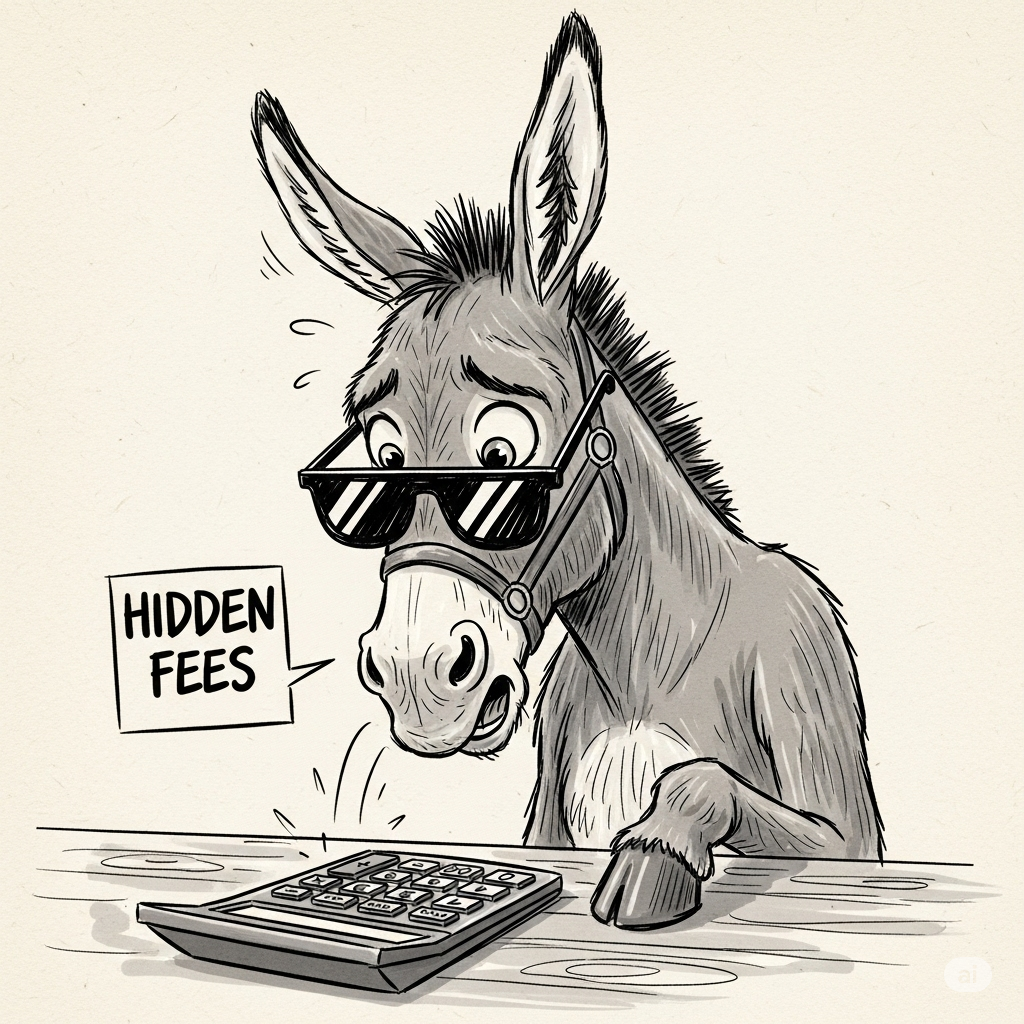
The Invisible Wealth Shredder: Why Investment Fees Matter
Years ago, I trusted a financial advisor who assured me a 1.5% annual fee was just the “industry standard” for active management.
When I finally crunched the numbers myself, I realized he was buying himself a shiny new European car with my retirement money. I fired him the next day.
The financial industry throws millions of dollars at slick advertising trying to keep their little secret from getting out. They count on your apathy, knowing it is hard to feel urgent about numbers that are decades away.
As you can see from your calculation, a 1.2% fee translates into a shocking 22.3% reduction in the value of your investments by age 65.
Think of it like renting a warehouse to store your household furniture. If the landlord charged a flat fee, that would be fair. But imagine if they took 1.5% of your actual furniture every single year—by year 20, they’ve walked off with your dining table, three chairs, and the couch. That is exactly what percentage fees do to your capital.
MER vs. Platform Fees: What’s the Difference?
Many investors do not realize they are being double-dipped by two distinct fee layers.
First, there is the Management Expense Ratio (MER). This is the fee charged directly by the fund manager (like Vanguard, Betashares, or a retail fund manager) to run the actual investments.
Second, there is the Platform Fee or administration fee. This is what your broker, wrap platform, or superannuation fund charges just for letting you hold the investments on their website.
If you pay a 0.3% MER and a 0.9% platform fee, you are paying a total fee of 1.2% per year. Both fees are quietly subtracted from your account balance, whether the market went up or down that year.
The Brutal Math: How a 1.2% Fee Difference Compounds Over 30 Years
Let’s look at a concrete example to see how the compounding math actually plays out.
Suppose you start with $50,000 and contribute $10,000 every year for 30 years. If your investments grow at an average rate of 8% per year before fees, your total wealth would grow to a massive $1,636,000.
But if you are stuck in a high-cost fund charging 1.2% in combined annual fees, your net return drops to 6.8% per year.
Over 30 years, your final balance is reduced to $1,271,000.
That seemingly minor 1.2% fee cost you $365,000 in cold, hard cash. That is nearly a quarter of your entire potential nest egg gone forever.
Stop paying the lazy tax. By switching to a low-fee super fund or broker, you can keep that $365k in your own pocket where it belongs.
What Can You Do About It?
First, find out exactly what you are paying. Go download your latest annual statement or Product Disclosure Statement (PDS) and look for the fees.
Second, compare your options. In Australia, a cheap passive ETF or low-cost super option should cost you under 0.2% to 0.3% per year.
Read about the joy of index investing to see how a low-cost portfolio works.
Frequently Asked Questions About Investment Fees
What is a reasonable investment fee?
For low-cost index investing or super funds in Australia, a reasonable combined fee (admin + investment fee) is under 0.2% to 0.3% per year. Paying anything close to 1.0% or higher is excessive and will significantly erode your long-term retirement balance.
How do percentage fees affect compound interest?
Percentage-based fees are calculated on your total investment balance, not just your profits. Since they are deducted every year—even during market downturns—they pull money out of your account that would otherwise grow and compound. The cumulative effect of this drag over 20 or 30 years is massive.
What is the difference between MER and platform fees?
The MER (Management Expense Ratio) is paid to the fund manager (like Vanguard) for managing the investments. The platform or administration fee is paid to the provider (like your super fund or online broker) for hosting your account, registry services, and online platform access.
How do I find out what fees my current fund is charging?
Check the Product Disclosure Statement (PDS) of your investment product or super fund, specifically looking at the “Fees and Costs” section. You can also view your annual statement, which is legally required to list the exact dollar amount of fees deducted from your account over the year.