The Psychology of Money: Why Your Mindset Eats Your Spreadsheet for Breakfast
Morgan Housel's The Psychology of Money proves that financial success is not about raw intelligence—it is about managing your own behavior. Here is what Australian investors need to know.

As a software engineer, I spent years assuming that financial success was purely a math problem.
I built complex financial spreadsheets, calculated optimal withdrawal rates down to four decimal places, and analyzed every ETF fee on the ASX.
Then I read Morgan Housel’s The Psychology of Money, and it slowly dawned on me: financial success is not a hard science, it is a soft skill.
Doing well with money has surprisingly little to do with how smart you are and everything to do with how you behave.
Why Spreadsheets Fail in the Real World
In software development, if your logic is clean and your algorithm is efficient, the code works every single time.
Finance does not work like that because human beings are driven by fear, greed, status, and ego rather than raw numbers.
You can be a genius at mathematics, but if you lose your head during a market crash, your spreadsheet is completely useless.
This is why high-earning professionals in Sydney and Melbourne frequently live paycheck to paycheck despite pulling in $250k salaries. They optimize their income on paper, but their psychology drives them straight into lifestyle inflation.
Luck vs. Skill: The Great Financial Illusion
Another profound lesson from Housel is how impossibly difficult it is to separate luck from skill in investing.
When someone hits a 10x return on a speculative stock or crypto coin, we praise their genius, but when another person loses their shirt doing the exact same thing, we blame their foolishness.
In reality, both outcomes are often dictated by forces of luck and risk that are far larger than individual skill.
Nothing is as good or as bad as it seems. Luck and risk are twin brothers, and it is almost impossible to tell where one ends and the other begins.
The truth is, even the smartest fund managers in the world cannot separate pure luck from genuine skill over short time horizons. That is why betting your financial future on stock-picking heroics is a fool’s errand compared to broad-market index ETFs.
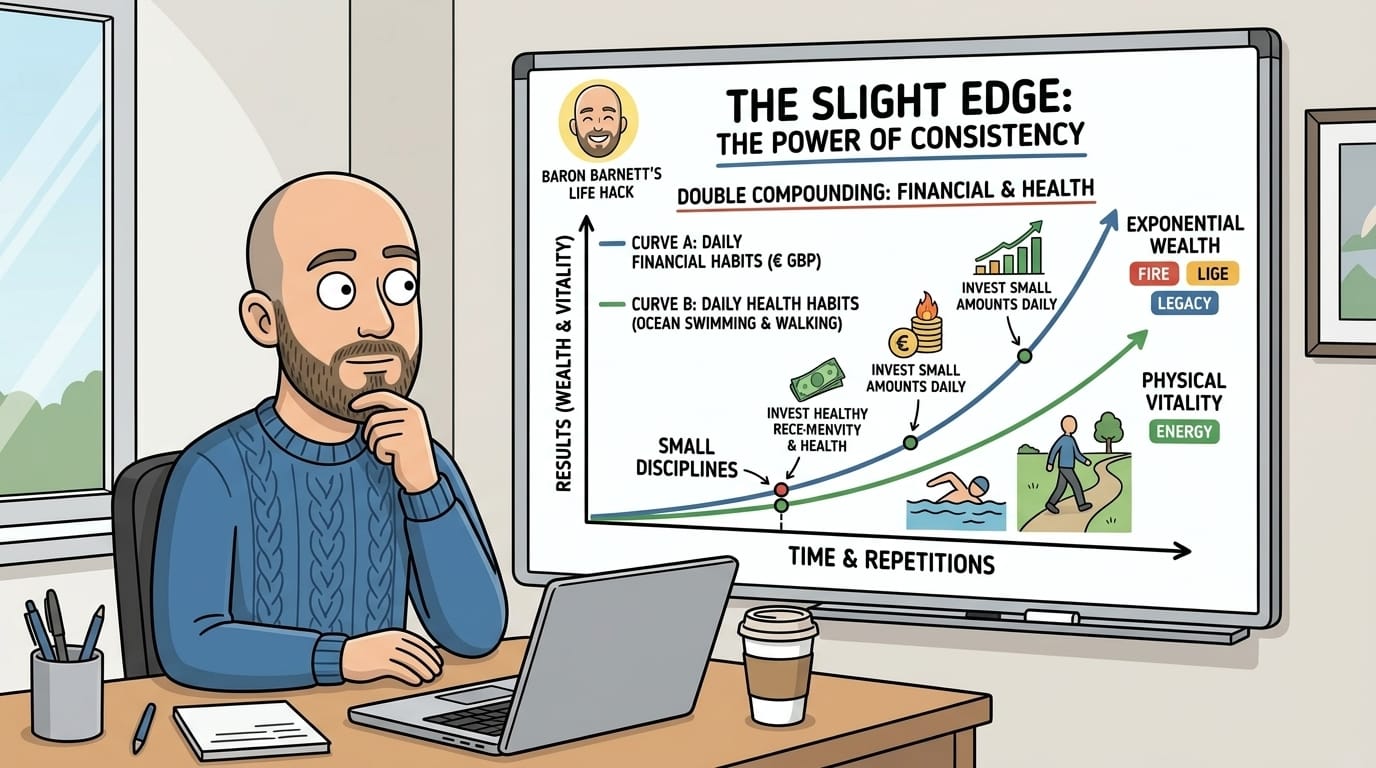
The Ice Age Secret of Compounding
Housel uses a fascinating historical analogy to explain compound growth: ice ages are not caused by brutal winters, but by slightly cooler summers.
When summer fails to melt the previous winter’s snow, that tiny leftover layer reflects sunlight, keeping the ground cool for the next year. Over thousands of years, that tiny microscopic advantage builds ice sheets miles thick.
Wealth works the exact same way:
Total Wealth = Initial Capital × (1 + r)n
Most investors obsess endlessly over maximizing the rate of return r. However, the real horsepower comes from n, the total time your capital sits undisturbed in the market.
Warren Buffett is widely regarded as the greatest investor of all time, but his secret was not just stock selection. Out of his massive net worth, over 99% was accumulated after his 50th birthday simply because he started investing at age ten and never stopped.
Getting Rich vs. Staying Rich: Two Different Skills
Getting rich requires taking calculated risks, being optimistic, and putting yourself out there.
Staying rich requires the exact opposite skills: humility, paranoia, and an obsession with survival.
Getting money requires risk. Keeping money requires paranoia. If you lose your room for error, a single bad year will wipe out a decade of progress.
In Australia, we see this trap constantly with property investors who leverage themselves to the eyeballs across five investment properties.
They look like geniuses during a boom, but when interest rates spike or tax rules change—like recent legislative tweaks to negative gearing and CGT discounts—their lack of cash flow margin wipes them out completely.
The Ultimate Superpower: Defining “Enough”
The hardest financial skill is getting the goalposts to stop moving.
When your income rises, your expectations rise right along with it, leaving you stuck on an endless hedonic treadmill.
If you constantly measure your success against your neighbors or colleagues, you will always feel poor no matter how much capital you accumulate.
Social comparison is a game you can only win by opting out entirely.
Money’s Highest Dividend: Controlling Your Time
The ultimate goal of financial independence is not buying luxury German sedans or flash watches.
The highest dividend money pays is the ability to wake up every morning and say, “I can do whatever I want today.”
Controlling your time is the single greatest lifestyle variable that predicts human happiness.
By automating your investments into low-cost index ETFs and maxing out your superannuation contributions, you are not just accumulating numbers on a screen; you are buying back your personal freedom.
Baron’s No-Bullshit Rule: Stop spending hours trying to outsmart the market with complex trading models. Focus on mastering your own behavior, define what “enough” means for your life, and let time and compounding do the heavy lifting.