The Slight Edge: Why Your Wealth and Health are Curved, Not Linear
Wealth and health are rarely a sudden leap; they are the compounding result of small, everyday decisions that are easy to do—and just as easy not to do.
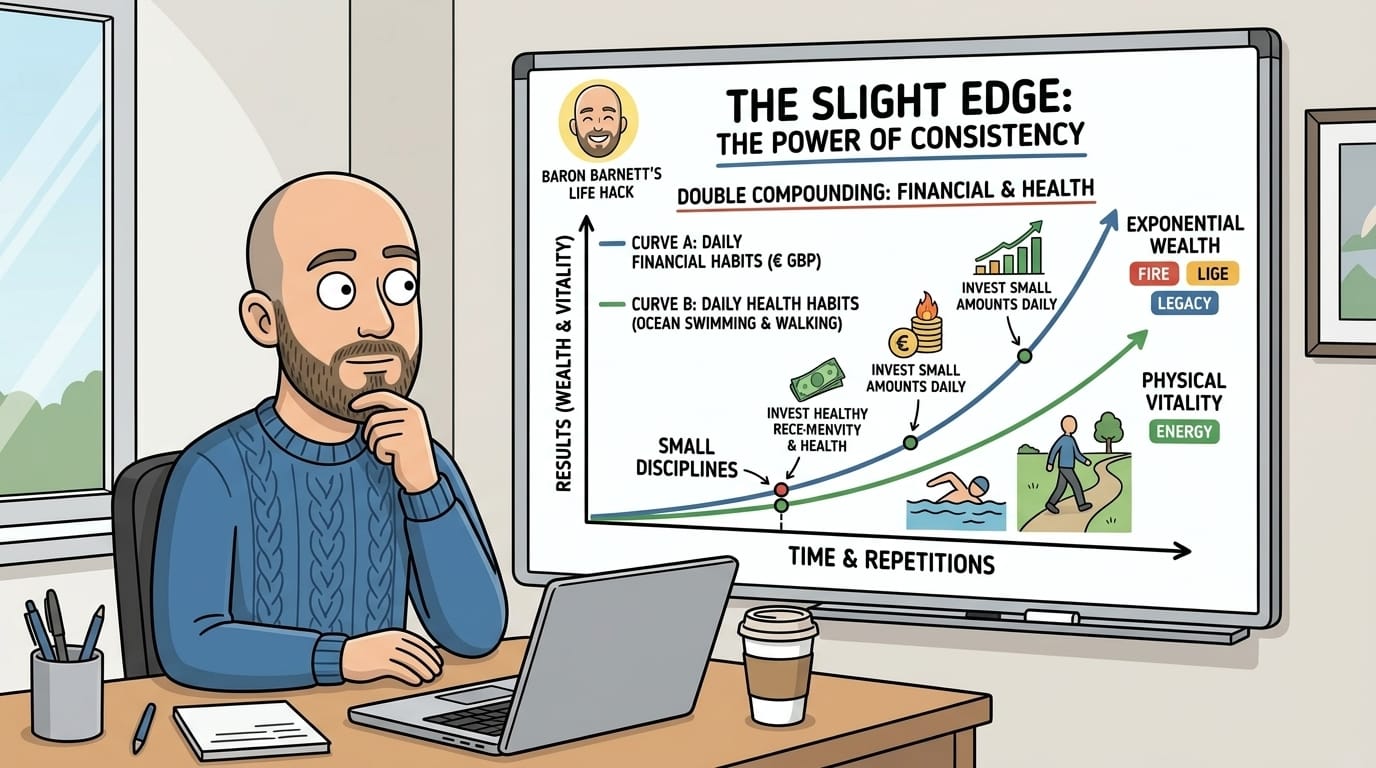
It can be easy to assume that building wealth requires a massive inheritance, a lucky break, or a stroke of pure genius. But the reality is often much more approachable.
Wealth is rarely a sudden leap; rather, it is the compounding result of small, everyday decisions that are easy to do—and just as easy not to do.
This is the core philosophy of Jeff Olson’s insightful book, The Slight Edge. Olson suggests that success isn’t a sudden event, but a gently sloping curve that moves up or down based on our daily habits.
You do not rise to the level of your goals; you fall to the level of your daily routines.
The Gentle Financial Curve
Wealth isn’t linear; it works on an exponential curve. Money naturally compounds, and having a bit of wealth makes it easier to gently grow more. On the flip side, debt can also spiral in the opposite direction if we aren’t careful.
Grabbing a six-dollar takeaway coffee every morning feels harmless, but over thirty years, that simple habit compounded at 8% could be worth over $250,000.
Alternatively, taking that same six dollars and quietly automating it into a broad-market index ETF each day puts us on the upward slope of that wealth curve. It takes patience for the curve to bend upward, but by sticking to low-cost index ETFs and letting investments simply sit, we can allow our wealth to quietly and steadily grow without friction.
The Double Curve: Wealth and Health
The Slight Edge philosophy applies just as beautifully to our well-being. Just like our finances, our physical health compounds over time.
For me, that tiny daily habit is swimming every day—preferably in the ocean, even through winter. Some days it is incredibly easy to justify skipping it, but not only do I feel amazing afterwards, I also feel it’s a vital investment in my future physical and mental health.
Choosing a salad over a heavy meal won’t transform us overnight, and missing one walk won’t ruin our health. But repeating those tiny choices daily for a decade can lead to life-altering differences.
Staying active tends to boost all the other parts of our body, while sitting too much can create a cascade of compounding problems. I’ve noticed that as people get older, losing the mobility to walk can sometimes lead to a rapid, compounded decline.
It’s a gentle reminder not to let our health flatline while we focus on our finances. Financial freedom is meant to be enjoyed with vitality and energy, after all.
Baron’s Takeaway: Focus a little less on the distant destination and instead audit the current trajectory. Consider picking just one tiny discipline today—like saving ten dollars a day or reading a few pages of a finance book—and make it a habit. It might feel completely insignificant today, but in ten years, it could quietly become the difference that gives you true freedom.