Don't Get Hung Up on Dividends: Why Total Return is the Real King of Wealth
Dividends feel like free money, but they aren't. Here is why focusing on dividends is a tax trap and why total return (capital growth + dividends) is what really matters.
There is a massive love affair in the personal finance world with dividends. People talk about dividends as if they’re some magical, risk-free stream of passive income. “It’s free money!” retirees shout from the rooftops. “I’m living off my dividend yields!”
I hate to burst your bubble, but it’s not free money. In fact, getting obsessed with dividends is one of the most common mental traps in investing. It’s the financial equivalent of taking $10 out of your left pocket, putting it in your right pocket, and celebrating your newfound wealth. Except, in the real world, the taxman stands right next to you and takes a bite of that $10 as it moves between pockets.
The Dividend Illusion: The Math They Ignore
Let’s clarify a basic rule of corporate finance: a dividend is not an extra bonus. It is literally a company deciding it has nothing better to do with its cash than to give it back to you. When a company pays a dividend, its value drops by the exact amount of that payout.
If you own 1,000 shares of a company trading at $100 per share, your investment is worth $100,000. If the company pays a $5 dividend, the share price drops to $95 on the ex-dividend date. You now have $95,000 in shares and $5,000 in cash. Your net wealth is still exactly $100,000 (minus the tax you’ll owe on that cash). You haven't made a single cent of profit. You've just been forced to liquidate 5% of your investment.
If you don't believe me, look at Warren Buffett. The Oracle of Omaha’s company, Berkshire Hathaway, has famously never paid a dividend. If Buffett needs cash, he simply sells a tiny sliver of his capital. It’s cleaner, more efficient, and doesn't trigger forced tax bills for millions of shareholders.
Dividend Investing vs Capital Gains: The Tax Trap
Here is where the dividend obsession gets really expensive: taxes. When you focus on dividend investing Australia, you are handing control over to the companies you own. They decide when to pay dividends, which means they decide when you get taxed.
If you are in your peak earning years, you might be paying a marginal tax rate of 37% or 45%. When those dividends land in your account, they get added to your income and taxed at that high rate. Sure, franking credits Australia help offset some of this corporate tax, but that only applies to domestic companies. If you hold US or international shares—which you should, unless you want your entire future tied to a few Aussie banks and miners—you don't get franking credits. You just get slammed with the full tax bill.
Compare that to capital gains investing. When you focus on capital growth, your wealth grows quietly inside the asset without triggering a tax event. **You only pay tax when you sell.**
This gives you two massive advantages:
- You control the timing: You can wait to sell until you’ve achieved FIRE or are taking a career break, when your taxable income is much lower (and your tax rate might be 0% or 19%).
- Tax-Efficient Rules (Replacing the old discount): Just when you think you've figured out the rules of their monopoly game, the government flips the board. While they are killing off the classic 50% capital gains tax discount from 1 July 2027, the new system still beats dividends. Under the new rules, your purchase price is indexed for inflation (CPI), meaning you only pay tax on your real profit, not inflation. And while there is a new 30% minimum tax rate floor, that is still a massive discount compared to paying up to 47% on forced dividends during your peak working years!
Total Return Investing: Think Big Picture
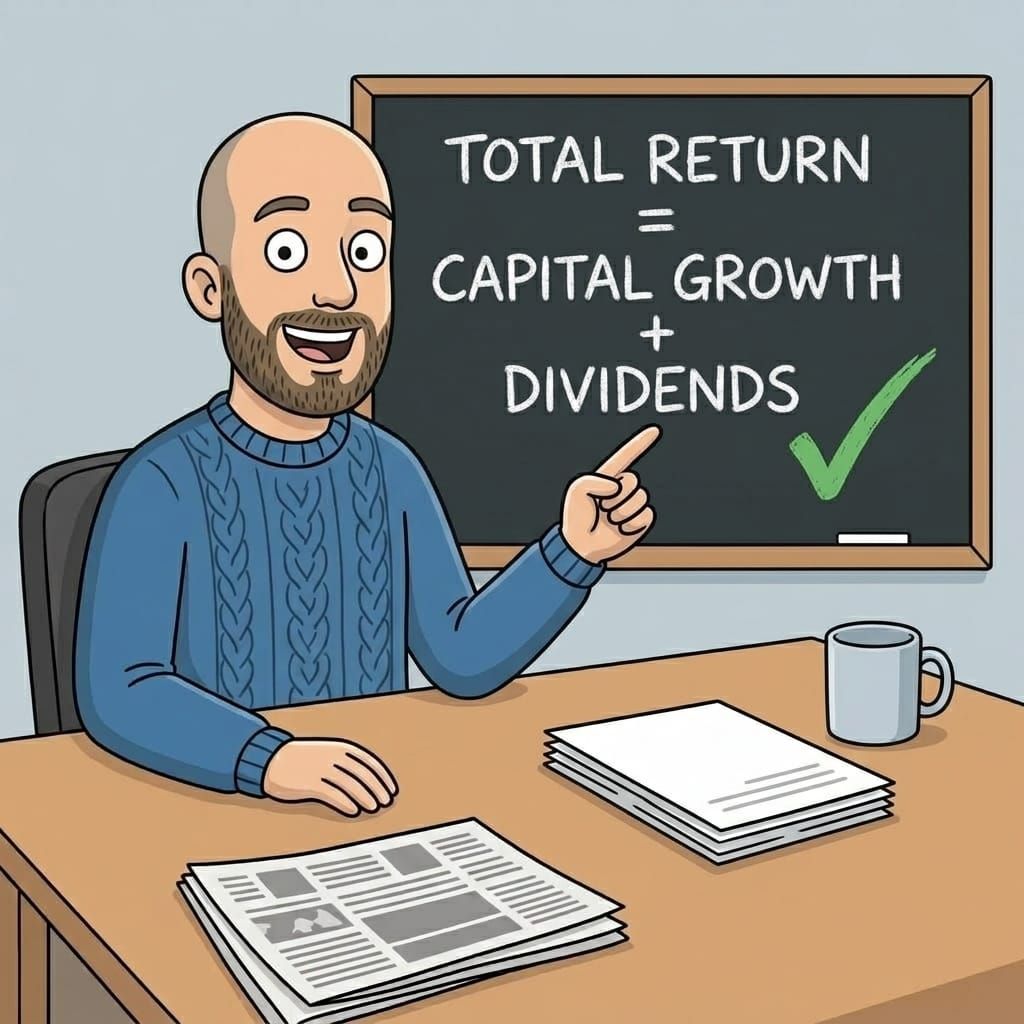
At the end of the day, you should only care about one metric: **Total Return** (Capital Growth + Dividends). A dollar of growth is worth exactly the same as a dollar of dividends—except growth is often tax-deferred and tax-discounted.
When you focus purely on high-dividend companies, you are often buying low-growth, legacy businesses. You might get a 6% yield, but if the share price is flat or falling, you’re losing out on the global compounding engine of modern growth stocks. As a former software engineer who watched tech eat the world, believe me: you do not want to miss out on capital growth just to collect a tiny quarterly check.
So, stop sorting shares by dividend yield. Look for the best overall businesses, buy low-cost diversified index ETFs, and focus on growing your total wealth. If you need cash, just sell a few units. It’s your money—you should decide when to pay tax on it.
Baron's No-Bullshit Rule: Stop treating dividends like free lunch. Focus on total return, let your capital grow tax-free, and sell on your own terms. Your future self will thank you for the tax savings.