Sensible Defaults: Stop Researching Every Purchase
Borrow a trick from software engineering. Pick a default store for each category, buy there by habit, and stop re-deciding the boring stuff.
Stop researching every purchase. Pick a default store for each category, buy there by habit, and only shop around when there’s a real reason to.
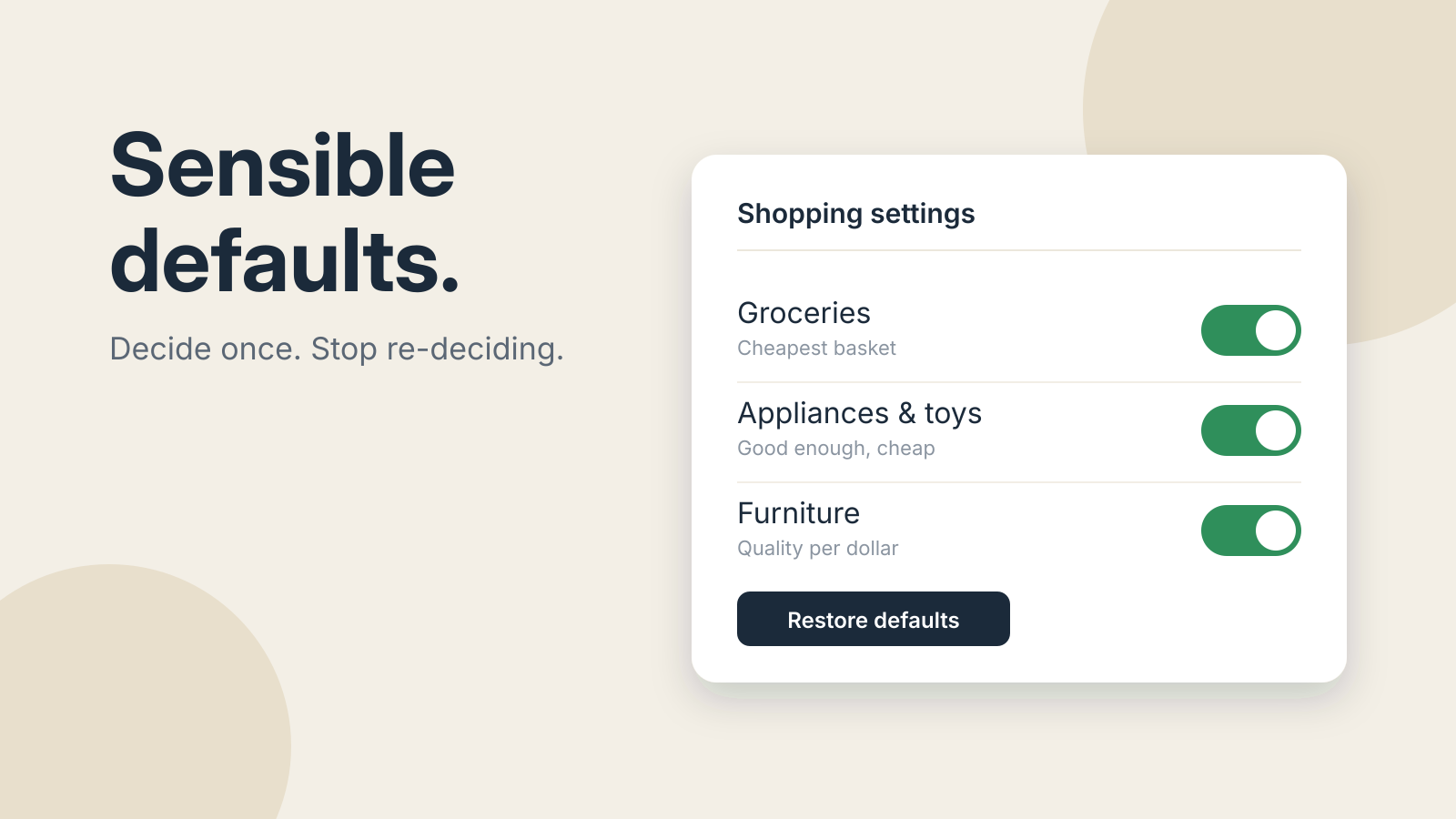
In software engineering there’s an idea called sensible defaults. A well-built tool ships with settings that work for 90% of people out of the box. You can change them, but you don’t have to. The engineer’s time goes on the 10% of problems that are actually unusual, not on re-deciding the boring stuff every time.
Your shopping should work the same way.
Why defaults save you money
Most money doesn’t leak through big decisions. It leaks through hundreds of small ones made tired, rushed or bored.
Every time you ask “where should I buy this?” you open the door to a worse answer: the store that’s closest, the brand you saw on Instagram, the place with the nicer lighting. Each one costs a few dollars. Over a year, that’s real money.
A default kills the question before it starts. You don’t compare five supermarkets every week. You go to the one that’s cheapest most of the time and get on with your life.
The secondary win is time. Comparison shopping feels productive, but an hour spent saving $4 is a bad hourly rate.
My defaults
| Category | Default | Why |
|---|---|---|
| Groceries | Aldi | Cheapest basket in Australia, consistently |
| Appliances, kids’ toys, homewares | Kmart | Cheap, good enough, easy returns |
| Furniture | Ikea | Decent quality per dollar, flat-pack, resaleable |
Groceries: Aldi
This one isn’t opinion. CHOICE’s March 2026 survey priced the same 17-item basket across 104 supermarkets: $75.98 at Aldi, $90.08 at Woolworths, $90.90 at Coles and $101.84 at IGA (source). Aldi stayed cheapest even after specials were counted.
That’s roughly 16% off your grocery bill for doing nothing clever. A household spending $250 a week saves around $2,000 a year.
The honest catch: Aldi doesn’t stock everything, and the same survey found its fresh fruit spoiled faster. So the default is Aldi for the bulk of the shop, with a top-up run elsewhere for the handful of things it doesn’t do well.
Appliances and kids’ toys: Kmart
A kettle is a kettle. A toaster is a toaster. Kids’ toys get broken, outgrown or forgotten within months.
Kmart is built for exactly this: functional stuff at prices low enough that you don’t care when it dies. Paying triple for a brand name on a toaster buys you a logo, not three times the toast.
Furniture: Ikea
Ikea is the sensible default for most furniture because it hits the sweet spot between price, quality and design. It’s not heirloom stuff, but it’s not landfill after one move either. The popular lines also hold resale value surprisingly well on Marketplace.
Yes, you have to build it. Consider the Allen key your discount.
We tested this recently on an outdoor dining set. Ikea had one for $529. Over at another retailer, a Black Friday sale had a table and chairs “reduced” from $4,000 to $2,000.
Half price sounds like a win. It isn’t. That set is still nearly four times the Ikea price, and it was overpriced at $2,000 too. The $4,000 tag isn’t there to sell the furniture. It’s there to make $2,000 feel cheap.
That’s anchoring, a bias Amos Tversky and Daniel Kahneman described in the 1970s (Kahneman covers it in Thinking, Fast and Slow). The first number you see becomes the reference point, and every number after it gets judged against that, not against what the thing is actually worth. Retailers know this, which is why the “was” price is always printed bigger than it deserves.
A default is the cure. When Ikea is your benchmark, the question stops being “how much am I saving?” and becomes “is this worth $1,471 more than the one I’d normally buy?” Usually it isn’t.
When to override a default
A default isn’t a religion. Good software lets you change the setting when you have a reason. Here are the reasons that count:
- You use it every day and it matters. Your mattress, office chair and work laptop are worth spending on. Hours of use justify the price.
- Cheap means replacing it twice. If the Kmart version will die in a year and a decent one lasts ten, the cheap one is the expensive one.
- Safety is involved. Car seats, helmets, anything electrical you’ll leave running unattended. Buy for the standard, not the price tag.
- There’s a genuine one-off deal. A clearance sale on something you were going to buy anyway. Not a “deal” on something you didn’t need.
“I felt like it” is not on the list. Neither is “it was on special.”
Set your own defaults
My list won’t be yours. If there’s no Aldi near you, or you hate flat-pack with a passion, pick something else. The point is to decide once.
- List the categories you buy from regularly.
- Pick the store that’s good enough and cheapest most of the time for each.
- Write it down and stop thinking about it.
- Review once a year, not once a week.
The best financial habits are the boring ones you don’t have to think about. Defaults are just that, applied to the checkout.
This article is general information only and doesn’t consider your personal circumstances. Prices quoted are from published surveys at the time of writing and will change.